You’ve got the plans laid out. Maybe it’s a new fence to keep the dog in, a sprinkler system for that patch of lawn that never quite makes it through August, or a small patio for weekend grilling. These projects feel straightforward. Dig a hole, set a post, run a pipe. Simple enough, right?
But here’s what nobody tells you at the home improvement store: the ground beneath your yard is packed with gas lines, electrical cables, water pipes, and communication lines. Hit one of them, and your weekend project turns into a serious problem. The average repair bill for a damaged utility line ranges from $3,500 to $4,000, according to a 2026 PG&E press release. That’s not counting the fines, the medical bills, or the risk to anyone standing nearby.
The good news? You can avoid every bit of it. The steps are simple, affordable, and don’t require any special skills. Here are the 9 things every homeowner needs to know before breaking ground.
1. Know When You Need a Private Utility Locator – Filling the gap 811 leaves behind

Blood Hound website
Blood Hound provides private utility locating services for residential properties in the Austin area.
Most homeowners know about 811. You call, they send someone out, and they mark the underground lines for free. That’s a great first step. But 811 only marks the public utility lines from the street to your meter. Everything on your side of that meter – the power line to your shed, the gas line for your grill, the buried sprinkler pipes, the invisible pet fence – is your responsibility. And 811 won’t find them.
For homeowners in Texas, working with a company that offers private utility locating in Austin fills exactly this gap. Private locators use ground-penetrating radar and electromagnetic detection to map every buried line on your property. It costs a fraction of what a single utility strike would. And it gives you a complete picture of what’s underground before you start digging.
2. Call 811 Before You Dig – It’s Free and Your Legal First Step
811 Before You Dig website
The 811 Before You Dig service dispatches utility companies to mark public lines at no cost to homeowners.
Before anything else, call 811 or visit the Call 811 Before You Dig page on the U.S. Department of Transportation website. It’s free. It’s the law in every state. And it gives you a 99% chance of avoiding an incident, according to the DOT.
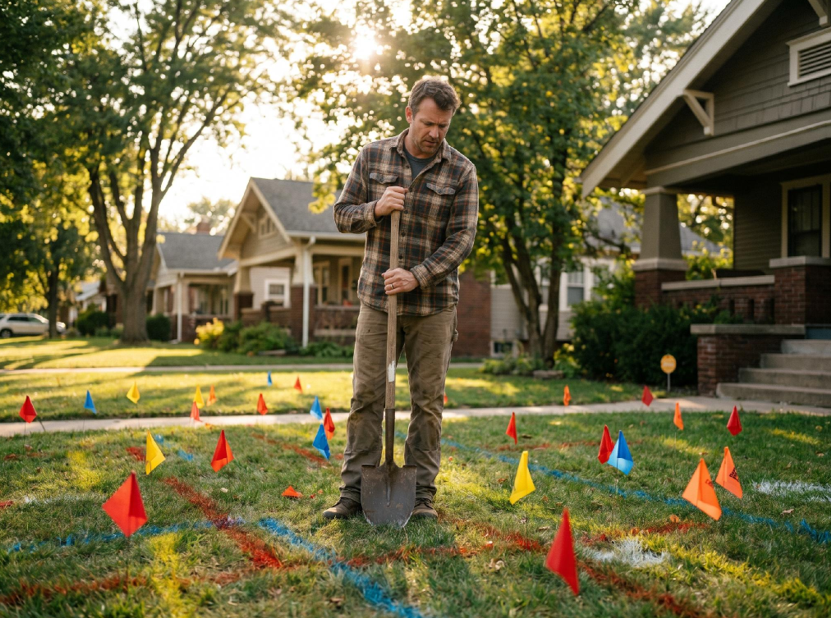
You need to call at least 3 business days before you plan to dig. Utility companies send technicians to mark the public lines with spray paint and flags – red for electric, yellow for gas, blue for water. We’ll get to that code system in a moment.
Nearly 200,000 buried utility lines are damaged by digging each year in the U.S., according to data presented at the Common Ground Alliance’s 2026 conference. The total annual cost exceeds $30 billion. And in 89% of cases where a homeowner damaged an underground line, 811 was never called at all, per PG&E’s 2025 North Coast data. That one free phone call could save you thousands.
3. The 5 Renovation Projects Most Likely to Hit a Utility Line
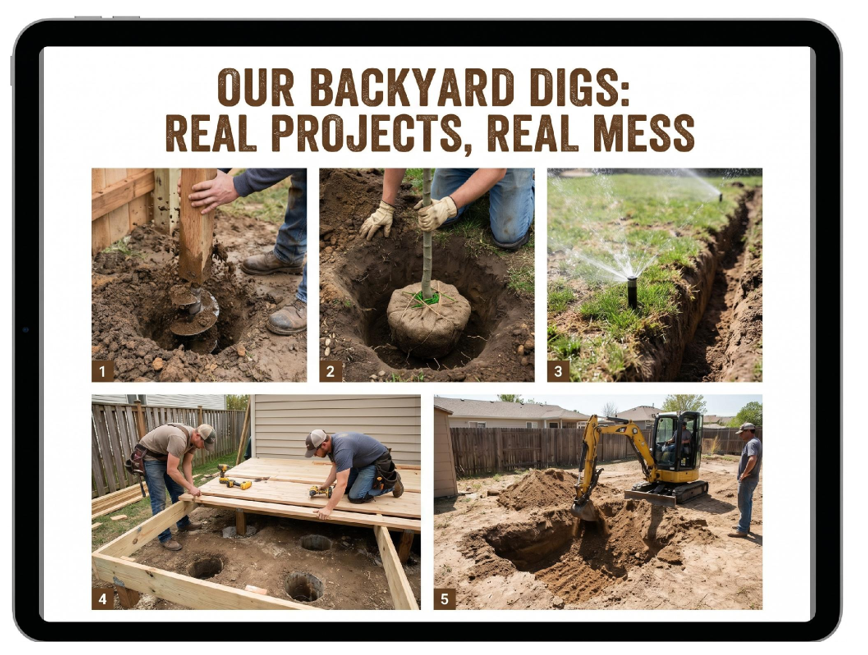
Fence posts, sprinklers, and tree planting are among the top causes of homeowner utility strikes.
Some projects carry more risk. Based on industry incident data, these 5 renovations account for most homeowner utility strikes:
- Fence installation: Post holes can punch through a gas line or an electrical cable buried just inches down.
- Tree and shrub planting: Digging a hole for a new tree seems harmless, but roots aren’t the only things underground.
- Sprinkler and irrigation systems: These require trenching across your entire yard. Sprinkler lines are often buried 6 to 12 inches deep, right where gas and electric lines sit.
- Deck and patio construction: Footings go deep. A standard 4×4 post hole can reach 3 to 4 feet down, well into the zone where buried utilities run.
- Pool or hot tub installation: In-ground pools require significant excavation. If there’s an unmarked line running through your backyard, you’ll find it the hard way.
A nationwide survey conducted by the Common Ground Alliance in February 2026 found that 74% of American homeowners plan an outdoor digging project in the next 12 months – more than 60 million households. And 10 million plan to skip calling 811 entirely. Don’t be one of them.
4. Know the Color Code Before You Dig
When utility companies mark your property, they use a standardized color system developed by the American Public Works Association. Red means electric power lines. Yellow means natural gas, oil, or steam. Orange means communications and cable TV. Blue means drinking water. Green means sewer and drain lines. White marks the proposed excavation area. Purple means reclaimed water or irrigation.
There’s also a tolerance zone you need to know. Within 18 to 24 inches on either side of a marked line, dig only by hand – no power tools or heavy equipment. Depth markings on flags are approximate. Soil shifts, lines settle, and a cable marked at 2 feet deep might be closer to the surface than you think.
5. Understand the Real Cost of a Utility Strike
That $3,500 to $4,000 repair bill? That’s just the direct cost. The Common Ground Alliance tracks utility damage data through its annual DIRT Report.
Factor in indirect costs – fines, medical expenses, legal liability, higher insurance premiums, and service disruptions – and the total can be 29 times higher than the direct repair bill, according to PG&E’s 2026 analysis. A $4,000 repair could turn into a $100,000 problem.
The 2024 DIRT Report found that failure to notify 811 before digging is the number one root cause of utility damage, accounting for 24.54% of all reported incidents. And it’s the easiest one to fix.
Compare that to private utility locating. For a typical residential property, a private locate runs between $200 and $600. That’s less than the deductible on most homeowners’ insurance policies.
6. How Private Utility Locating Works
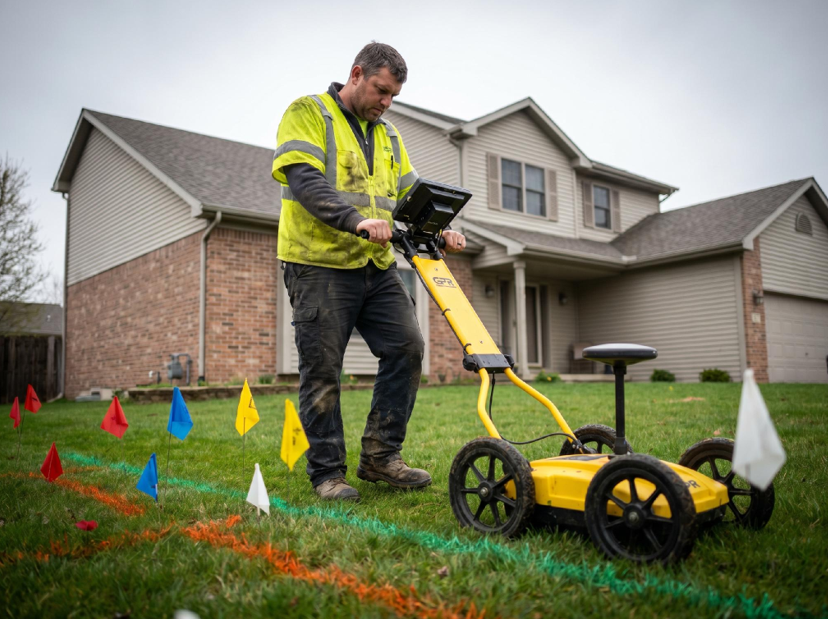
Ground-penetrating radar (GPR) is the gold standard for finding both metallic and non-metallic buried utilities.
Private locators rely on two technologies. Ground-penetrating radar (GPR) sends radar pulses into the ground and measures reflections. It can detect both metallic and non-metallic objects – plastic water pipes, fiber optic cables, and old concrete foundations. According to GPRS, one of the industry’s largest private locating firms, GPR is the only technology that can reliably find non-metallic utilities.
Electromagnetic (EM) locating detects the field around metallic lines – power cables, gas pipes, copper lines. Many locators use both technologies together.
The technician marks everything with paint, provides depth readings, and can give you GPS coordinates for each line. That information becomes a permanent underground map of your property. Private locators can usually respond same-day, compared to the 2 to 5-day wait for public 811 locators.
7. The 5-Step Safe Digging Process Every Homeowner Should Follow
Once you understand the risks, the process is straightforward:
- Step 1: White-line your dig area. Mark the outline of your planned excavation with white spray paint or flags. This tells locators exactly where you’re working.
- Step 2: Call 811 at least 3 business days ahead. Give yourself a buffer. Weekends and holidays don’t count.
- Step 3: Wait for all utilities to respond. Not every company responds on the same schedule. Wait until all marks are in place.
- Step 4: Hire a private locator for everything past the meter. 811 stops at your meter. A private locator covers the rest.
- Step 5: Hand digs within the tolerance zone: Keep power tools 18 to 24 inches from any marked line. Use a shovel. Take your time.
This approach matches the same thoughtfulness we cover in our sustainable living and design guide. Good planning up front saves money and materials later.
8. Don’t Forget About Abandoned Lines
Older homes come with buried history. If your house was built before 2000, someone may have buried a gas line for a grill that’s long gone, run power to a shed that was torn down, or installed a sprinkler system that was later abandoned.
These lines won’t show up on any 811 map. Utility companies have no record because a previous owner installed them. But they’re still in the ground. And they’re still dangerous.
If your property has been around for decades, assume there are things buried that nobody remembers. A private locator’s GPR can find them, even if they’re disconnected.
9. Build a Permanent Record of Your Underground Layout
Once your property has been located, document everything. Take photos. Save the locate report. Note any GPS coordinates the technician provided. Store it somewhere you won’t lose it – cloud storage, a home server, a printed copy in your home file.
This record becomes invaluable for future projects. Next time you want to plant a tree, install a water feature, or run a new electrical line, the map is ready to go. No second-guessing.
It’s also a selling point if you ever sell your home. A documented underground utility map tells buyers that the property has been well cared for, down to what they can’t see.
For more on making your home smarter, check out our guide to the latest smart home gadgets that help you track every part of your property.
A Small Step That Prevents Big Mistakes
Home renovation and landscaping projects are exciting. They make your home feel more like yours. But what’s hidden underground can derail both your budget and your safety. The fix is simple: call 811 first, hire a private locator for everything beyond the meter, hand dig near marked lines, and keep a permanent record of what you find.
A few hundred dollars and a little planning are all it takes. Compared to a $4,000 repair bill or worse, that’s not even a choice.
 Betsylie Sheetsin – Home Renovation Expert
Betsylie Sheetsin serves as the Home Renovation Expert at Castle Shelf House, specializing in giving practical advice for both small and large-scale home improvements. With years of experience in construction and renovation, Betsylie understands the importance of blending durability with design. Her insights into home renovation projects, along with expert advice on the latest materials and techniques, empower homeowners to tackle even the most ambitious projects confidently.
Betsylie Sheetsin – Home Renovation Expert
Betsylie Sheetsin serves as the Home Renovation Expert at Castle Shelf House, specializing in giving practical advice for both small and large-scale home improvements. With years of experience in construction and renovation, Betsylie understands the importance of blending durability with design. Her insights into home renovation projects, along with expert advice on the latest materials and techniques, empower homeowners to tackle even the most ambitious projects confidently.