Your walls say something about who you are. Most people know this, but still end up with a generic print from a big-box store because it’s the easiest option. That’s fine – but it’s not the only option, and it’s definitely not the most interesting one.
Mass-produced decor creates a strange sameness across homes. You’ve probably seen the same black-and-white botanical prints in three different friends’ living rooms. Personalized art fixes this, but hiring an artist costs real money, and the selection of genuinely custom pieces online is either limited or expensive. That’s where DIY comes in.
According to Mintel’s 2025 US Arts and Crafts Consumer Report, 71% of U.S. consumers identify as crafters. This suggests making something for your walls isn’t a niche pursuit – it’s what most people are already inclined to do. The projects below run the full spectrum from beginner-friendly to mildly skilled, and they work across budgets, room sizes, and design styles.
1. Custom Paint-by-Numbers Kit – Finished Art That’s Genuinely Yours
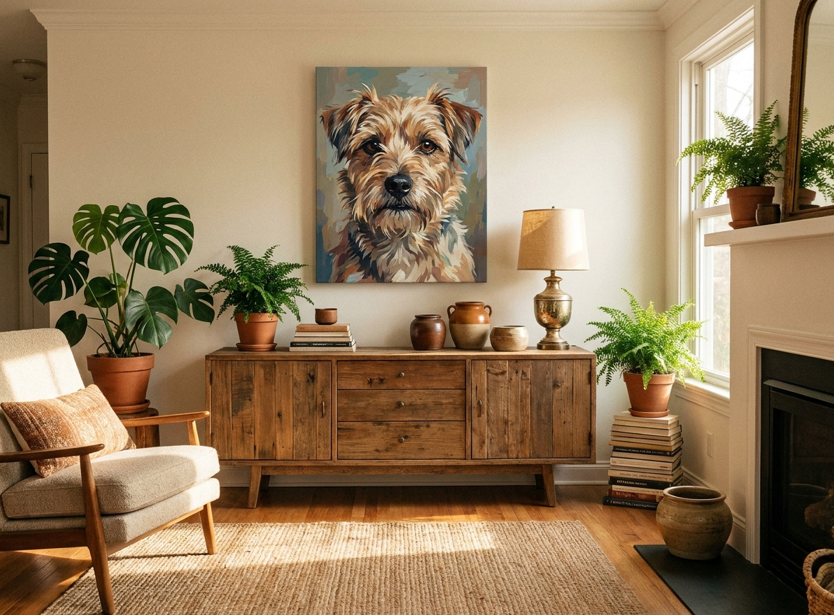
A finished custom paint-by-numbers portrait becomes striking, one-of-a-kind wall art in any living room.
A custom paint-by-numbers kit converts one of your own photos into a numbered canvas you paint section by section. The process is slower than buying a print, but the result is something no one else owns.
Services like Number Artist convert your photo into a ready-to-paint kit, so the finished piece on your wall is entirely your own – a pet, a portrait, a landscape you photographed yourself. Each kit arrives with the printed canvas, all the numbered paints, and brushes, so there’s nothing extra to source.
The format works well in living rooms, bedrooms, and hallways. Oversized wall art is the #2 fastest-growing home decor trend heading into 2026, according to data from Davincified cited by RetailTimes – and a finished paint-by-numbers canvas is naturally large-format. Research on creative activity also shows that just 45 minutes of painting can significantly lower cortisol levels, inducing a focused, meditative state. You get something from it while you’re doing it: a calmer hour plus a finished piece for the wall.
Practical tip: choose a high-contrast photo for the clearest numbered breakdown. Pets and people with a plain background work especially well.
2. Stretched Fabric Canvas Panel – Large-Scale Art for Under $30
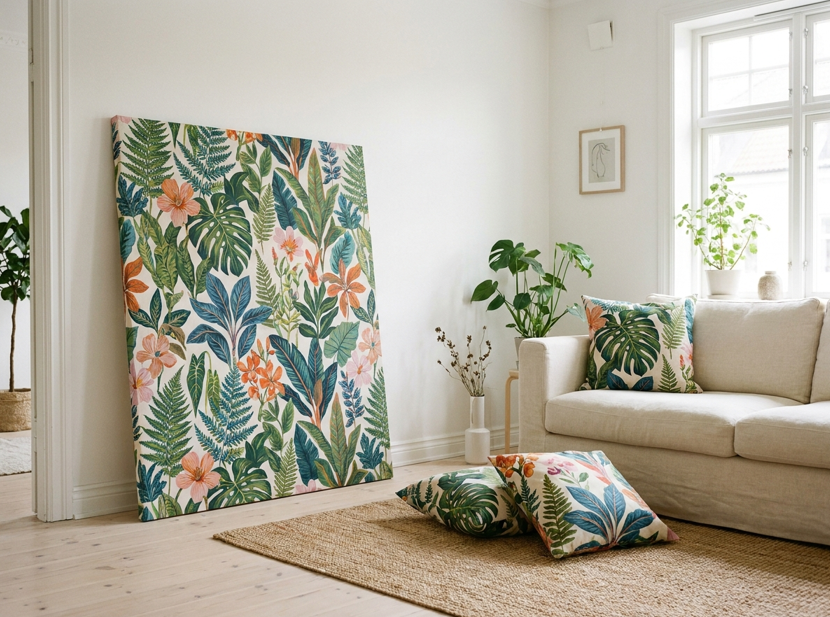
Stretched fabric panels deliver gallery-scale art at a fraction of the price of a commissioned painting.
Take a piece of decorative fabric – botanical, geometric, abstract, anything with a print you like – and stretch it over a wooden frame the same way a painter stretches canvas. Mount it on the wall, and you’ve got oversized art for less than the cost of a restaurant meal for two.
It’s a beginner project that takes about an hour. Buy fabric at 1.5x the size of your frame, pull it taut over the back, and use a staple gun to secure it – no sewing required. The best part is that it’s swappable. Change the fabric when you redecorate, swap it seasonally, or use the same frame three different ways over a few years.
Design-wise, bold textile prints work in maximalist spaces, while neutral linen and textured weaves fit Japandi-style rooms. Skill level: genuine beginner. Time: 45 to 90 minutes.
3. Gallery Wall with Mixed Frames – The Personal Museum Approach
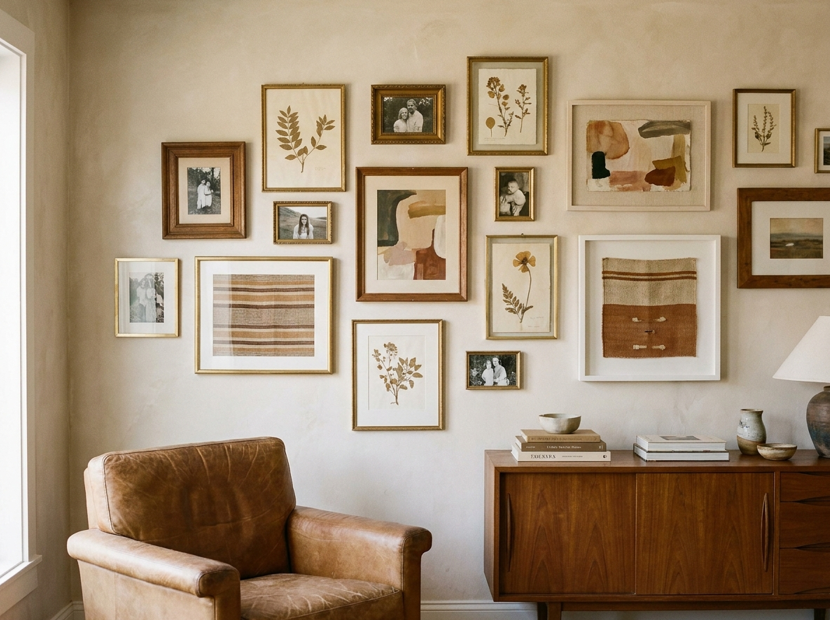
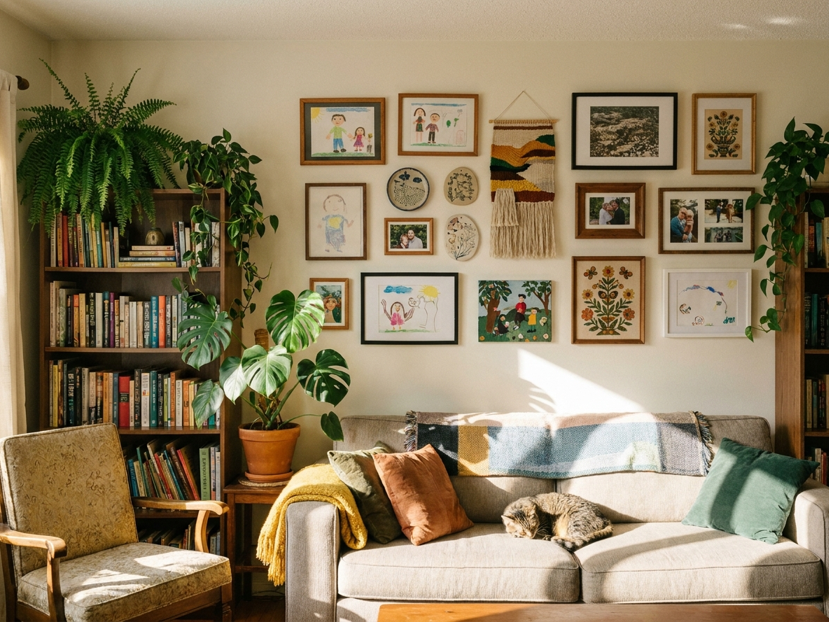
A gallery wall blends personal photos, DIY prints, and thrifted frames into a curated wall display.
A gallery wall is a collection of frames in varying sizes hung together as one visual group. Photos, postcards, small canvases, a pressed botanical print, a kid’s drawing – anything goes, and the combination is what makes it personal.
According to 2026 trend data from Davincified via RetailTimes, “large wall art” receives 33,100 monthly Google searches. A gallery wall achieves that visual weight without requiring a single large statement piece. It’s ideal if you have photos you’ve never printed, art you’ve made but never displayed, or thrift store frames sitting in a closet.
The trick to making it look intentional: trace each frame on kraft paper, cut out the shapes, and tape them to the wall first. Lay the full arrangement on the floor before committing any nails. Keep one consistent element throughout – matching frame colors OR matching mat colors, not both – and the mix reads as curated rather than chaotic.
Understanding which interior design trends are shaping homes in 2026 makes it easier to choose a palette that’ll feel current rather than dated by next year.
4. Geometric Tape Wall Mural – Renter-Friendly and Free to Remove
This one costs less than a pizza and leaves no permanent mark on the wall.
Washi tape or painter’s tape applied directly to the wall in geometric patterns – triangles, diamonds, herringbone – creates a graphic accent effect without any painting. It’s fully removable, which makes it the only project on this list that renters can do without consequence.
Mural wallpaper Google searches increased 1,150% in 2025 compared to 2024, according to RetailTimes – that’s how much appetite there is for the bold-wall look. Geometric tape delivers the same visual effect for around $15. It works well on accent walls, in home offices, and in nurseries where you want something graphic but not permanent.
Practical tip: use a level and measuring tape to keep lines straight. If you’re working over freshly painted walls, remove the tape while the paint is still very slightly tacky – it pulls cleaner than removing from fully cured paint.
5. Macrame Wall Hanging – Texture That Reads as Art
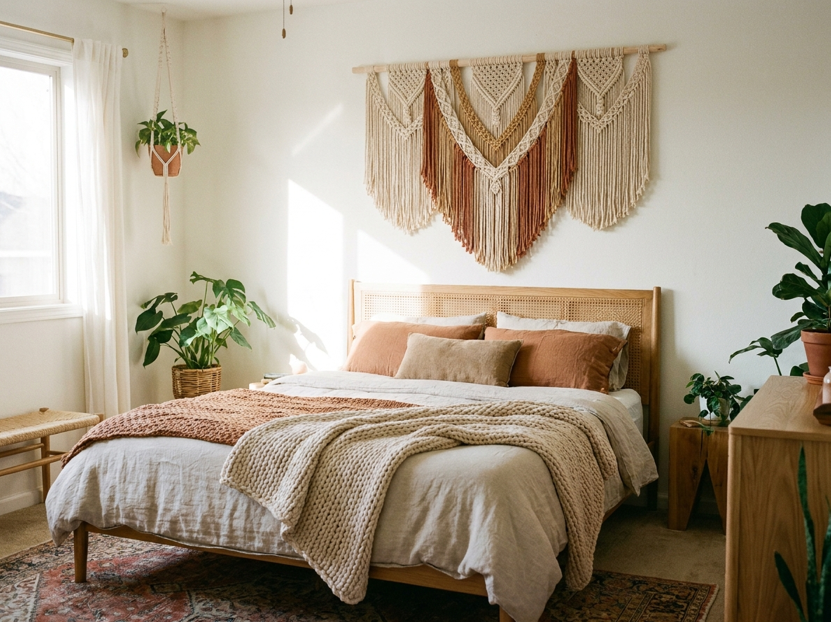
A handmade macrame wall hanging adds texture and warmth to a bedroom without a single nail hole in the plaster.
Macrame is knotted cotton rope mounted on a wooden dowel. The result is a large, textural piece that adds depth to a flat wall – something no print or canvas can do. It fits the biophilic design trend well: natural materials, organic shapes, nothing synthetic.
Pinterest searches for “hand-painted wall patterns” rose 60% according to Accio.com’s 2025 DIY Trends report, reflecting a wider move toward tactile, handmade surfaces. Macrame is part of that same instinct.
A simple spiral knot pattern is where beginners should start. Use 3mm single-strand cotton rope – it’s the easiest to knot and the most forgiving when you make mistakes. A 5-foot hanging takes about 3 hours and costs roughly $20 in materials. If you’re drawn to natural textures and materials, castleshelfhouse.com’s guide to sustainable design principles for your home covers how to bring more of that ethos indoors.
6. Pressed Botanical Frame Art – Free Materials from Your Garden
Pressed botanicals are one of the best-looking DIY projects for the effort involved. Flowers, ferns, and leaves pressed flat and mounted under glass look polished and considered. The materials are often free if you have a garden, a yard, or even a nearby park.
Press your botanicals under heavy books for 2 to 3 weeks. Use acid-free paper between the pages to prevent browning. Once dry, mount them in a standard glass-front frame against a white or black mat. The result looks like something from a botanical shop, and costs almost nothing.
Design fit: kitchens, bathrooms, and entryways work especially well. The small scale of individual botanicals suits the narrower wall space in those rooms, and the organic shapes bring a quiet, natural quality that works in nearly any palette.
7. Typography Quote Canvas – Art That Means Something Specific to You
A typography canvas is a phrase, word, or short quote hand-lettered or stenciled onto a stretched canvas or wooden board. It’s deeply personal – your words, your handwriting, your choice of what matters enough to put on the wall permanently.
This project doesn’t require calligraphy skills. Vinyl stencil letters give clean, even lines that look professional. Chalk paint on a dark canvas creates a chalkboard-style finish; acrylic on white canvas is more versatile and pairs with almost any room color.
The wellness angle here is worth noting. According to the US Chamber of Commerce, stress is a primary driver of the crafts market’s growth – adults are picking up creative hobbies specifically to decompress. Typography projects are satisfying in a particular way, because you’re making a decision about what matters, then building something around it.
Best rooms: entryways, home offices, and kids’ rooms where a specific message has context and meaning.
8. Layered Wood Cutout Art – Three-Dimensional Wall Pieces
Flat prints are the default. This project does the opposite: layered wooden shapes mounted at different depths create a 3D wall piece with actual shadow and dimension.
Buy thin plywood or balsa wood sheets from a craft store. Cut or purchase pre-cut shapes – leaves, geometric forms, abstract silhouettes. Paint or stain each layer a different shade before assembling, so the depth contrast reads clearly. Mount to the wall using small spacers between layers.
It works best above sofas, mantels, or beds where a large focal-point piece makes sense. The 0.26% year-over-year growth in hand-painted tiles as a trend, noted by Davincified, reflects the same appetite for artisan, textured surfaces – and layered wood art delivers that feeling at home without commission costs.
9. Watercolor Wash Abstract Canvas – No Wrong Answer Required
Watercolor on canvas sounds like it requires skill. It genuinely doesn’t, and abstract application is the reason.
Loose, flowing watercolor applied in organic shapes – wet the canvas first, drop in color, let it bloom – produces work that looks intentional whether or not it was. The imperfection is the point. A $12 set of watercolors from any craft store is enough to get started.
Mintel’s 2025 US Arts and Crafts Consumer Report found that nearly half of U.S. adults seek creative hobbies specifically to manage stress. Painting consistently shows up in that context, and for good reason: the low-stakes nature of abstract work removes the biggest barrier to starting. There’s no reference photo to match, no lettering to keep even, no pattern to follow.
Practical tip: layer light colors first, then dark. Let each layer dry completely before adding the next, or the colors muddy. A hairdryer speeds this up significantly.
10. Personalized Photo Transfer on Wood – Family Photos with an Artisan Finish
A photo transfer takes a printed image and moves it onto a raw wood panel using Mod Podge. The result looks aged and handmade – like something you’d find at a craft market, except it’s a photo from your own camera roll.
The technique works best with a laser print (not inkjet – the toner transfers, the ink doesn’t). Apply Mod Podge to the wood panel, press the photo face-down, let it dry overnight, then wet the paper and rub it away. The image stays embedded in the dried Mod Podge layer.
This project suits rustic, farmhouse, and warm-modern interiors. Family photos take on a completely different quality in this format – less like a snapshot, more like a keepsake. Every piece is unique because the transfer process introduces slight variations each time.
Choosing the Right Project for Your Space
Not every room wants the same type of art. Matching scale, material, and mood to the specific space makes the difference between a project that looks placed and one that looks planned.
Living rooms: go big. Paint-by-numbers canvases, gallery walls, and stretched fabric panels all have the visual weight a living room wall needs. Bedrooms: prioritize texture. Macrame, botanical frames, and watercolor washes create a softer, more personal atmosphere than graphic or typographic pieces. Kitchens and hallways: smaller and simpler works better. Typography canvases and photo transfers fit narrow walls without crowding them.
Mix two or three different project types throughout your home rather than repeating one. The collected-over-time look – varied materials, varied scales, varied subjects – is what makes a home feel lived-in rather than decorated. If you’re planning a full room refresh around your new art, these budget-friendly home transformation ideas cover the bigger picture without requiring a designer’s budget.
Nine of these ten projects cost under $50 in materials. Custom paint-by-numbers kits are the investment item – but they yield the most visually striking result, and no one else will have the same one. The most interesting walls aren’t bought. They’re built, a few weekends at a time.
 Betsylie Sheetsin – Home Renovation Expert
Betsylie Sheetsin serves as the Home Renovation Expert at Castle Shelf House, specializing in giving practical advice for both small and large-scale home improvements. With years of experience in construction and renovation, Betsylie understands the importance of blending durability with design. Her insights into home renovation projects, along with expert advice on the latest materials and techniques, empower homeowners to tackle even the most ambitious projects confidently.
Betsylie Sheetsin – Home Renovation Expert
Betsylie Sheetsin serves as the Home Renovation Expert at Castle Shelf House, specializing in giving practical advice for both small and large-scale home improvements. With years of experience in construction and renovation, Betsylie understands the importance of blending durability with design. Her insights into home renovation projects, along with expert advice on the latest materials and techniques, empower homeowners to tackle even the most ambitious projects confidently.